gentle giants & tiny truths
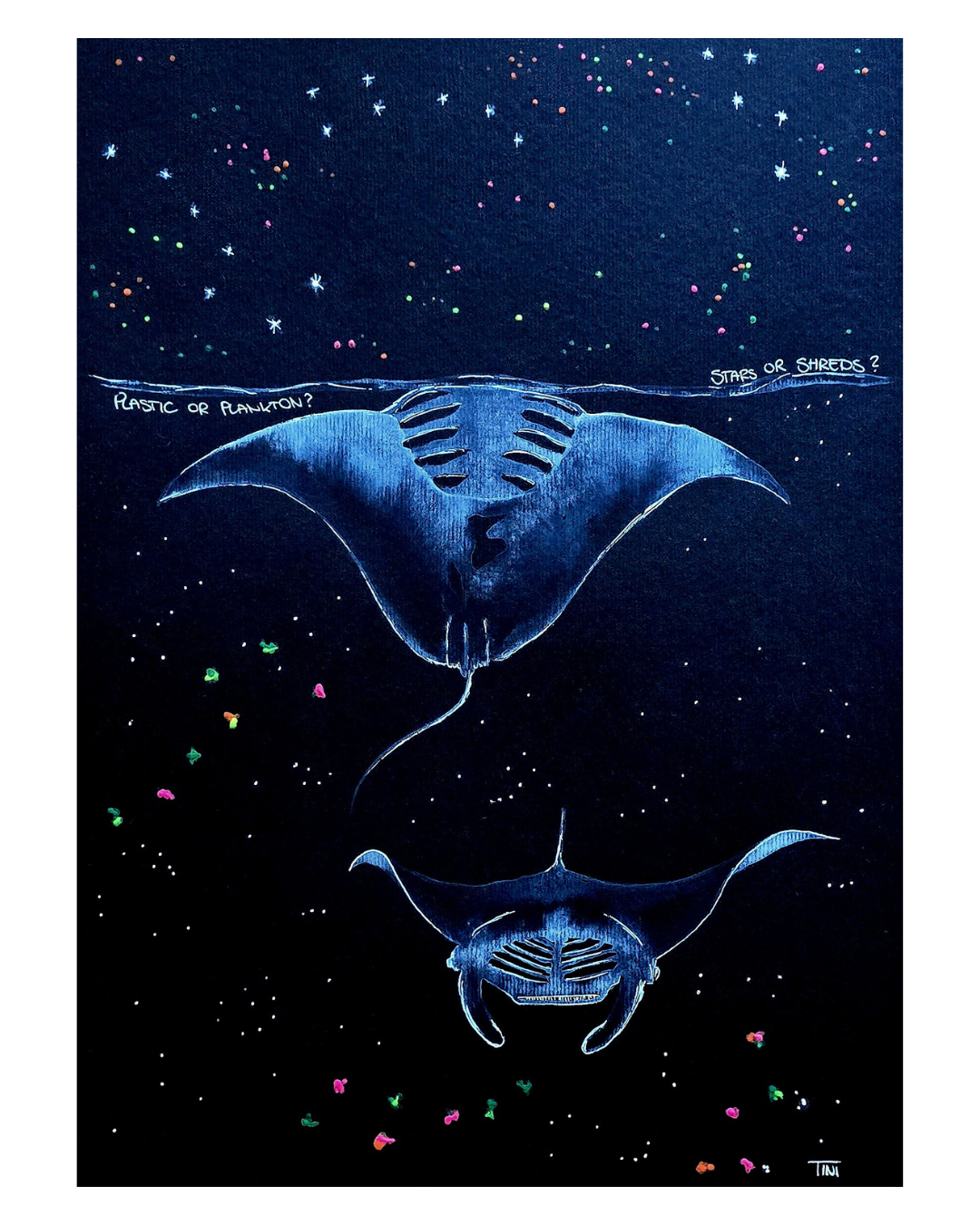
Zooplankton may be tiny, but they are the ocean’s quiet force—feeding whales, fish, and countless marine creatures, while anchoring the entire food web. As they drift through the sea, they also play a vital role in the Earth’s carbon cycle, helping to move carbon from the surface to the deep ocean and quietly regulating our climate. Without them, the ocean would lose its rhythm, and the planet its balance.
But today, this fragile system is under threat. Microplastics are mistaken for food by zooplankton and small fish, and pass silently through the mouths of filter feeders like manta rays and whales. These particles interfere with feeding, growth, and reproduction, weakening entire marine systems.
And they don’t stay in the sea—microplastics have been found in the atmosphere, in drinking water, table salt… and even the human body.
What begins as our waste ends as a shared burden. But there is hope, because nature has already shown us a better way.
Unlike industrial filters that clog or fail when exposed to microplastics, manta rays have evolved a clog-resistant filtration system that operates without active pumping or maintenance. Their unique gill structure separates plankton from particles with high efficiency—offering a passive, low-energy model for microplastic filtration. Nature has already solved the problem we still struggle to address.